
Our LUNZ Footprint research project establishes a UK-wide Living Lab to develop and evaluate a scalable auditable farm- and food-level GHG accounting framework to sustainably reduce GHG emissions. This Living Lab will work with and engage different people and organisations on their net zero journeys.
In addition to GHG calculations we will be looking at how the assessments build capacity and net zero literacy, testing predictions of sequestration by hedges and trees, assessing validation methods and exploring the governance and equity implications of scaling. In summary, we are working together to provide evidence about how effective and informed usage of GHG accounting tools can be achieved in order to inform policy and help achieve a net zero transition.
Project work packages and deliverables
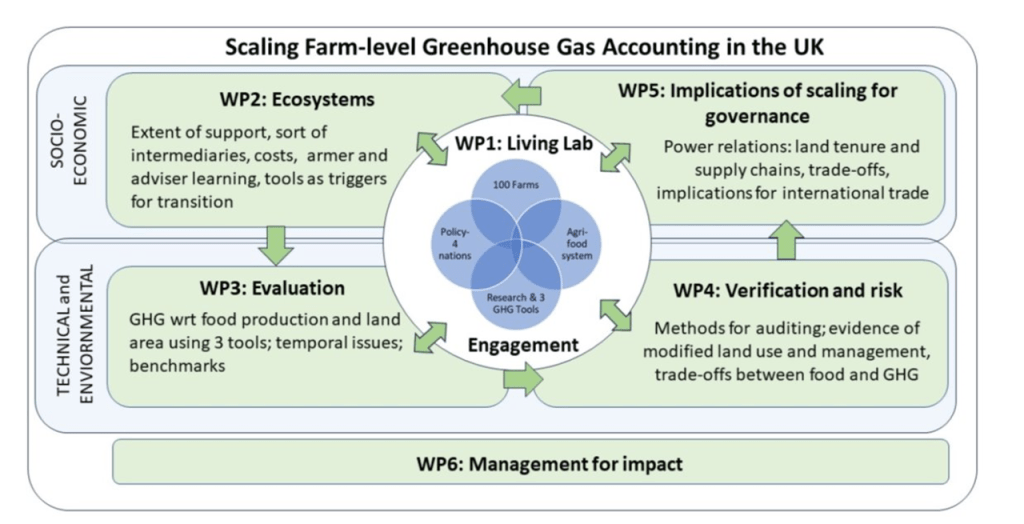
Work Package 1 (WP1): The Living Lab
- D1.1. Initial Living Lab workshops in each of four nations
- D1.2. Online workshops led by each GHG calculator company
- D1.3. Completed research ethics and data management protocols
- D1.4. Collection of first year of data inputs for 100 farms
- D1.5. Collection of second year of data inputs for 100 farms
- D1.6. Final Living Lab workshops in each of four nations
WP2: Supporting learning and change (‘Ecosystems’)
- D2.1. Learning and capacity-building evaluation framework
- D2.2. Report on GHG accounting ecosystems and the effect of support/advice
- D2.3. Synthesis report for policymakers recommending how GHG accounting can be most effectively used to foster learning and practice change
WP3: GHG accounting: evaluation and benchmarking
- D3.1. A common data input proforma addressing the data input needs for each tool
- D3.2. Initial benchmark briefing on mean emissions (per ha and per kg food) for eight farm types
- D3.3. Guidance on improving assumed net GHG emissions and their temporal variation of woodlands and hedgerows within GHG calculators
- D3.4. Policy briefing based on results for stratified farm types
- D3.5. Paper on technical improvements of the GHG models during the project
WP4: GHG accounting: verification and risk
- D4.1. Guidelines for policymakers on the verification requirements of stakeholders in the value chain, including permanence
- D4.2. Independent audited report of the costs and benefits of verifying GHG accounts
- D4.3. Review of the risk associated with carbon stocks including the effect of climate change
WP5: Implications of scaling for Governance
- D5.1. Report on stakeholder mapping and the vision of processor/retailers on GHG accounting, including attitudes to domestic v imported food
- D5.2. Report on the case studies of GHG accounting on landlord-tenant relationships
- D5.3. Report on the effect of farmer engagement in processor/retailer relationships
- D5.4. Design of governance principles for GHG accounting systems to ensure a just transition
WP6: Management and communication
- D6.1. Reports on meeting of Steering Group
- D6.2. Equality, Diversity and Inclusion (EDI) strategy completed
- D6.3. Reports on Risk Matrix, EDI, Responsible Research and Innovation (RRI) and Ethics
- D6.4. Impact pathway developed
- D6.5. Dissemination and communication Strategy and implementation
- D6.6. Delivery of updated BASIS and Future Farmer GHG accounting module
 LUNZ Footprint