
9 February 2026
Greenhouse gas (GHG) assessment tools are becoming a more familiar part of the agricultural landscape as supply chains and governments strive to meet their net zero commitments. In theory, these tools should help farmers understand GHG emissions on their farms, identify mitigation options and support better decision-making.
But to what extent do they do this in practice?
Workshops held across England, Scotland, Wales and Northern Ireland collected views on this question from a range of stakeholders representing: the farming and advisory community, policy makers, the supply chain, researchers, GHG tool companies and NGOs.

Regional differences
Responses to the workshop question: “To what extent are farm greenhouse gas carbon accounting tools helping farmers to change or think about change in practice?” reveal a mixed picture:
- England and Scotland: some 50% of respondents agreed the tools help farmers a lot or considerably.
- Wales: although some 29% of respondents thought that tools helped farmers considerably, the majority (>50%) said they helped only a little.
- Northern Ireland: the least positive view with most agreeing that the tools only helped a little, not at all or didn’t know.
Although these are only indicative (n= 122), and dependent on the types of stakeholder who attended the workshops, the differences likely reflect regional policy contexts and experiences. It is also notable that some 20% of respondents in each region replied ‘don’t know’ to the question, suggesting a general lack of awareness or experience with the tools.
Multifaceted challenges
Stakeholders suggest that while some farmers and advisers are using GHG tools confidently and productively, many remain confused, sceptical or disengaged. The challenges are multifaceted and these are compounded by the fragmented net zero landscape with multiple of tools, metrics, standards and messages, often with little guidance on how they relate to one another.
Three key areas for improvement to help farmers benefit from GHG tools were identified:
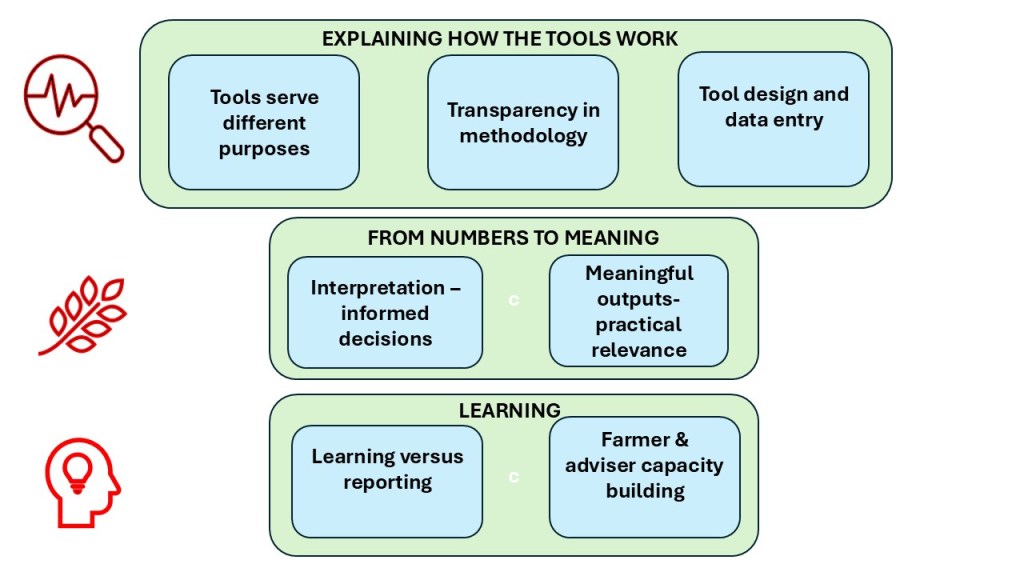
Explaining how the tools work
Farmers tend to be sceptical of the value and credibility of the tools, particularly when they generate different results for the same farm. Calls for harmonisation, standardisation and consistent messages were common across the workshops and the need for better communication identified.
Whilst there was broad agreement that some degree of standardisation would help, tool specialists highlighted the need to explain that the tools have been developed to address different questions and that there are inherent differences in methodologies. Stakeholders agreed that users would benefit from a good understanding of why and how the tools have been developed, the standards and emission factors used, the boundaries (farm or enterprise or product) and scope (inclusion of sequestration) of analysis and for what purpose. Such communication would help users navigate this landscape.
Improving transparency and clarity around methodologies was another area of agreement. Tools are commonly perceived as “black boxes”, with unclear assumptions and methodologies. Equally there is sometimes mistrust in the numbers “because farmers think that calculators aren’t calculating the way they want it to be calculated” and they question the standards and emission factors used.
Ease of data input and integration with other systems was highlighted by many stakeholders as needing to address the time and cost involved for farmers. Specialists, however, stressed that the quality of data should not be compromised as this can have a significant impact on the results.
Moving from numbers to meaning
Another strong theme was how to make the GHG assessment meaningful through informed interpretation, stressing the relevance to farm businesses, and integrating the assessment with other environmental outcomes.
Interpreting the assessment and enabling decision support are important. Stakeholders stressed the need to recognise the tools’ strengths and weaknesses, and not to just focus on a single number. They identified these key messages for farmers
• Benchmarking your own farm year-on-year is better than benchmarking against other farms
• Year-on-year trends are more meaningful than single-year results
• Footprints can legitimately go up as well as down
• Context matters, including weather, system type, yields, and business structure
One of the clearest messages from the workshops was that farmers engage better when GHG tools are relevant to farm businesses and are linked to what matters to them day to day. That means moving beyond GHGs as an abstract concept and connecting it to business performance, profitability, efficiency and resilience. As one stakeholder noted, practices that reduce emissions often also reduce bills. The financial benefits of efficiency gains from reduced input costs, improved nutrient management and better soil health are typically more relatable for farmers than net zero targets.
Knowledge needs to be contextualised and reflect what farmers care about, not just global climate targets. There were also strong calls to better reflect broader environmental outcomes from farms in the accounting. Many farmers, particularly those managing extensive or regenerative systems, feel unfairly judged by GHG-only metrics that overlook biodiversity, habitat protection and other ecosystem services. Stakeholders argued that focusing solely on GHGs risks undermining trust and alienating farmers who are delivering multiple public goods.
Enhancing learning
Using the tools to enhance and support learning about GHG and mitigation practices was a recurrent point of discussion across the workshops. This can be achieved through supporting farmers to explore the consequences of different decisions and building capacity in the farming and advisory community.
A distinction emerged between tools used for learning and decision-making, and tools used primarily for reporting and compliance. Many farmers see GHG assessments required by supply chains as a box-ticking exercise that benefits retailers not themselves. However, some stakeholders highlighted positive examples where supply chain actors actively support farmers to understand results and use them constructively. Independently, farmers who are engaging most positively with tools tend to be those who can use them to explore “what if?” scenarios and see the implications of management changes.
Stakeholders were clear that tools do not build capacity on their own. Training, advice and peer to peer learning are critical. Training and practical support for farmers was considered important to build capacity and empower farmers in their use of the tools. Suggestions for achieving this included better feedback to farmers with measurable action points, practical solutions and shared best practices through peer to peer learning, demonstration farms, farm networks and “champion farmers” sharing honest experiences.
Building a supportive and knowledgeable advisory community was emphasised as important with the need for holistic advisory support that links GHG emissions to business performance, resilience and wider environmental outcomes identified. However, how to achieve this was debated as expecting one adviser to cover everything was widely seen as unrealistic. Some advisers understand GHG accounting but lack practical mitigation expertise; others know farming systems well but lack confidence with climate tools. It was also agreed that as well as skills, the capacity of advisory organisations needs strengthening for the future.
So, are GHG tools benefiting farmers?
The answer from stakeholders is: sometimes – but not consistently. Where tools are transparent, well-supported and clearly linked to farm priorities, they can be powerful learning aids. Where they are imposed, poorly explained or narrowly framed, they risk becoming a source of confusion and mistrust.
The challenge ahead is not just improving tools themselves, but strengthening the relationships, communication and support systems around them. Examples where this happens already exist and if that can be scaled up, GHG assessment has the potential to move from a compliance burden to a genuinely useful part of farm decision-making.
 LUNZ Footprint