
25 March 2025
This second LUNZ Footprint feedback meeting involved everyone in our Living Lab and discussed getting value out of GHG tools.
Initial product-level footprint analysis
An initial analysis by Cool Farm of the 2024 results from 29 farmers and around 80 product-level assessments across a range of crops and livestock showed:
– considerable variation both between and within crops. For example, the 12 barley assessments revealed a wide range of emissions per tonne depending on fertiliser type and application rate.
– for cattle, emissions per kilogram of milk or beef were heavily influenced by herd dynamics, such as whether a farmer was building up stock or in full production because the assessment is based on produce sold.
Annual yield variation which is often outside a farmer’s control can also significantly shift footprinting figures from year to year.
Why different GHG tools give different results
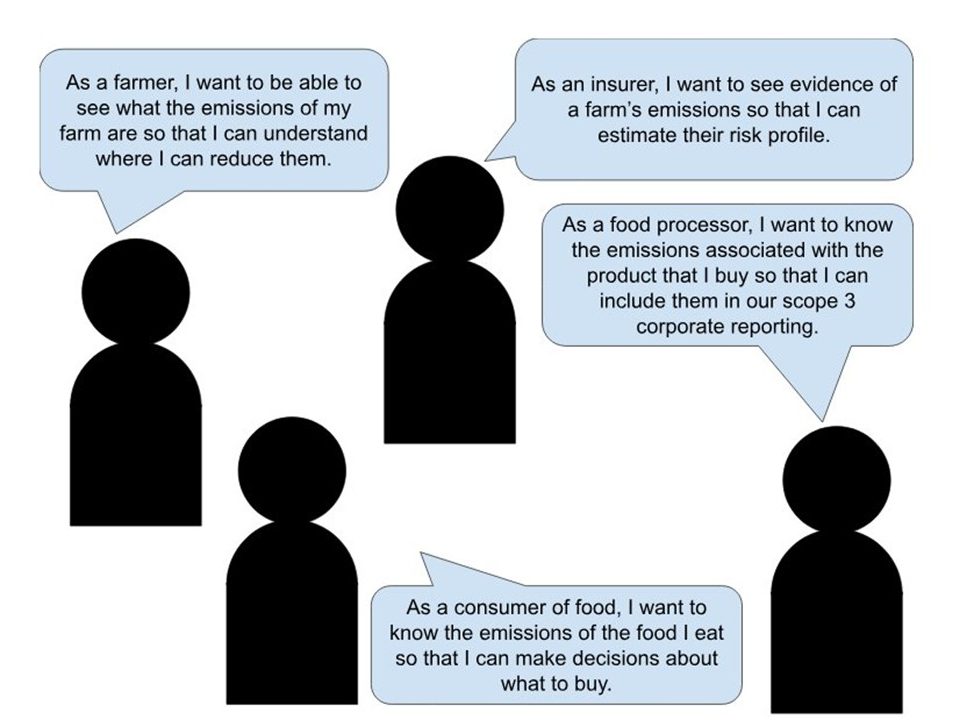
A key reason for different values from different GHG calculators is that each tool has been developed for a different audience – farm-level management, supply chain product assessments, or consumer-facing transparency. While most GHG tools share a common core covering Scope 1, 2, and 3 emissions, they can vary in the emission factors they use and in what additional elements they include, such as diversification activities, additional carbon sequestration in soils and hedgerows, or how feed and manure flows are handled. Understanding these differences can explain the variation in results.
Making improvements
Farmers shared experiences of reducing their GHG footprints, with the key wins identified as minimising bought-in inputs, integrating farm enterprises to reduce purchased feed, and optimising slurry and manure management to cut reliance on inorganic fertiliser. Herbal leys were particularly valuable to farmers in the room – reducing fertiliser needs and proving more resilient than ryegrass during drought conditions, though matching the requirements of the animals being grazed and maintaining sward diversity with sheep remain challenges. Some felt that additional soil carbon sequestration was not fairly reflected while others considered sequestration as a bonus given its likely limitations.
‘This is my first … and I’m just getting used to it and trying to look at the figures and see how I can improve on them, efficiency-wise.’
Arable farmer‘We’ve recently just put in a robotic milking system, which I’m quite excited to do our GHG footprint next year, because we’ve gone down by 50 cows and our overall milk yield is higher than we were doing previously.’
Arable and dairy farmer
Feeling undervalued
One farmer reflected candidly on the emotional toll of farming and GHG footprinting, noting that discovering his entire farm’s emissions equated to just two transatlantic flights left him feeling undervalued despite decades of effort with regenerative practices, stewardship schemes, and environmental conservation. He expressed frustration that agriculture appears to bear a disproportionate share of climate scrutiny compared to other industries, and that farmers are poor at communicating their positive story. He was very disappointed at the poor financial returns from the market for months of detailed data submission on his practices raising serious questions about who ultimately bears the cost of data collection and who profits from it. It was felt that large food businesses should be paying fairly for this data, that sequestration from hedgerows, cover crops and woodlands remains poorly recognised, and that recent SFI changes were challenging at exactly the moment farmers need long-term certainty.
‘I felt undervalued and I felt really upset about it. There’s a great feeling from knowing what my output is and what I’m trying to do and how I can try and improve it. But it just brought into stark reality about my tiny little farm and me…. trying to do our best.’
Mixed farmer
Learning not reporting
Farmers agreed that GHG calculators are useful as directional tools for identifying where emissions are concentrated and tracking improvement over time but stressed they should never be treated as precise judgements. One farmer described using results to prioritise action — tackling energy first, then imported feed — with tangible business benefits, including now exporting more power than he consumes. A central frustration was the way Scope 3 emissions from fertiliser production, feed, and other inputs are effectively “crystallised” on the farm, making farmers fearful that the responsibility for emissions generated far beyond their farm gate sits with them alone. This feeds into a broader concern about carbon leakage: tightening UK regulations without equivalent import standards simply shifts production, and emissions, abroad. Farmers called for a level playing field, with some interested in finding out more about the pros and cons of a Carbon Border Adjustment Mechanism for agriculture to ensure imports are held to comparable environmental and welfare standards.
‘In my case, it’s driven positive change, it’s saved me money, it’s made let me make good choices, but it’s treated as a training and a learning tool. And the best benefit from a GHG tool is if it helps farmers to see what their base case is and redesign or alter the system. It’s not about reporting numbers that are used by other people as a stick to beat us with.’
Mixed farmer
‘Carrots are a low nitrogen crop in terms of they’re not that hungry, they don’t want too much fertiliser, but we move a lot of soil. And of course, now is all about not moving soil. But do you want us to grow carrots or not?’ Vegetable grower
Other challenges
Farmers raised questions about how sequestration from scrub, hedgerows, and soil organic carbon is captured in GHG tools. There was the desire to compare results within sectors and across different tools. There was concern about calculator updates and what this means for meaningful year-on-year comparison.
‘We’d be really interested in knowing how we can manage things like scrub that are successional … I’m super interested in my low stocking rate beef system that has multiple benefits, not just protein production.’
Livestock farmer
Read more about our Living Lab approach here.
 LUNZ Footprint