
Verity Harrison, Michelle Cain, Paul J. Burgess, and Ceris Jones
In their natural state, peatlands are valuable carbon sinks as their waterlogged condition prevents the decomposition of organic matter and carbon remains stored as plant material (Evans et al., 2023). However, drainage of peatlands for agricultural production has led them to become greenhouse gas (GHG) sources rather than sinks emitting methane, nitrous oxide and carbon dioxide (CO2). Peatland emissions have only recently (2021) been included within the UK GHG Inventory, and they are substantial. UK peatlands in 2018 emitted about 16.1 Mt CO2e (IUCN UK, 2021), which represents about 3.8% of UK territorial GHG emissions, including land use. This major release makes it useful to account for peatland emissions and to understand how farm management can reduce emissions.
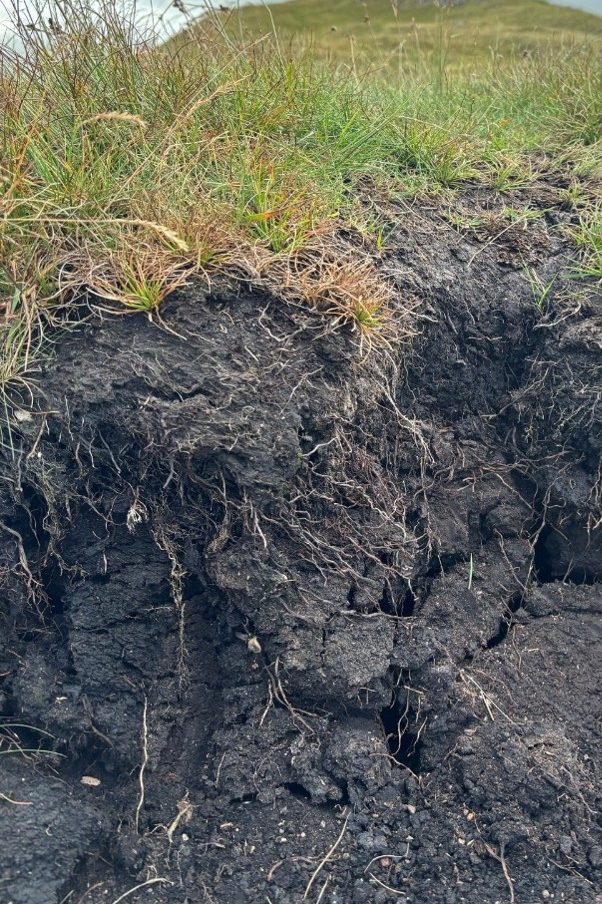
What about peatland emissions in GHG tools?
Peatlands are complex systems with emissions impacted by a range of factors, making it difficult to include their impact in GHG calculator tools. For example, increases in mean water table depth (WTD, the distance between the peat surface and the saturated zone), creating drier conditions, leads to higher CO2 emissions (Ge, 2003; Evans et al., 2016). However, water tables that are near the soil surface, producing wetter conditions, results in higher CH4 emissions (Evans et al., 2016).
Currently, the GHG calculators are at different stages of integrating peatland emissions into their tools. Farm Carbon Toolkit currently incorporates peatland emissions as part of their land management practice module; modelling GHGs for both cultivated and uncultivated peatland using UK-specific estimates derived from a Tier 2 approach (Farm Carbon Toolkit, 2025). Although Cool Farm includes the effect of the use of peat soil when using plug plants in crop production, it does not currently address sequestration or emissions from peatland. Nevertheless, it is in the process of formulating a Tier 1 peatland emissions model for land-use on peat soils (Cool Farm Alliance, 2025). Agrecalc is investigating the use of Tier 2 peatland emissions approach in the near future.
What are the challenges with incorporating peatlands in GHG assessments?
There are a number of shared challenges in terms of incorporating sequestration by or emissions from peatland soils.
There are a number of shared challenges in terms of incorporating sequestration by or emissions from peatland soils.
- Farmer capacity: is one of the main barriers identified by the calculators to detailed accounting of peatlands; in particular the balance between the data required to run detailed models with the capacity of farmers to provide the data required. For example, it is not easy to continuously measure the depth to the water table over time, in a way that summarises the average effect in a field.
- Categorisation and extent of peatland types: although Evans et al. (2023) specified a range of emission factors for different peatland categories, identifying which peatland category is most appropriate can sometimes be unclear. For example, there are substantially different emission rates for ‘extensive grassland’ and ‘modified bog – grass covered’. There can also be difficulties in assessing the extent of peatland on a farm – some definitions specify that peat soils should have a minimum depth of 40-50 cm, whereas emissions can still occur from shallower depths.
- The lack of data and evidence: there remains a need for greater evidence and data for peatland emission factors, which can address different locations (upland and lowland), peatland condition (natural, drained, or re-wetted), land cover, and water table depths. For example, a specific issue raised by the calculators was that currently at the IPCC Tier 1 level, there are no default emission factors for particulate organic carbon (POC) or dissolved inorganic carbon (DIC) (carbon loss pathways) due to insufficient data.
One current research initiative that is seeking to improve the assessment of peatland emissions is the University of Leicester’s Digital Twin programme. This should partially improve peatland emissions factors although largely limited to the fenlands and focused on CO2 emissions only (Digital Twin Hub, 2024).
What does all this mean?
Emissions from peatland are an important source of emissions from land use and agriculture, and ideally these emissions should be included in farm-scale and product-scale GHG assessments. However, it is only relatively recently that emission factors for different peatland types in the UK have become available. Recent research has demonstrated the importance of the water table depth in determining GHG emissions, and it is not easy to derive representative data for individual fields or time periods.
Moreover, understanding GHG emissions is only the first step. There is also a need for advice that balances the needs for continued food production with guidance on how to reduce emissions (Wentworth, 2022). This would help provide farmers with the practical, real-world information they need to reduce their emissions.
Acknowledgements: Verity Harrison completed this work as part of a CENTA Research Experience Placement, which provides experience in seeing how academic literature and real-world practice interface. We are thankful to Agrecalc, Cool Farm and Farm Carbon Toolkit for taking the time to explain their calculators and to provide the useful insights that have made the project possible.
References
- Booysen, J., Booysen, W. and Kleingeld, M. (2018). A risk management strategy to identify and prioritise factors affecting industry’s carbon tax liability. South African Journal of Industrial Engineering, [online] 29(3), pp.29–30. doi:10.7166/29-3-2046.
- Brown, P., Cardenas, L., Del Vento, S., Karagianni, E., MacCarthy, J., Mullen, P., Passant, N., Richmond, B., Thistlethwaite, G., Thomson, A., Wakeling, D., Choudrie, S., Smith, H. and Turtle, L. (2021). UK Greenhouse Gas Inventory, 1990 to 2019: Annual Report for Submission under the Framework Convention on Climate Change. [online] GOV.UK, BEIS, pp.1–601. Available at: https://uk-air.defra.gov.uk/reports/cat09/2105061125_ukghgi-90-19_Main_Issue_1.pdf
- Cool Farm Alliance (2025). Cool Farm Tool and Platform – Technical Method Description – CFP version 3 and CFT version 2. [online] Cool Farm Tool. Available at: https://coolfarm.org/
- Digital Twin Hub (2024). Self-Learning Digital Twins Transform Sustainable Land Management. [online] Digital Twin Hub. Available at: https://digitaltwinhub.co.uk/self-learning-digital-twin-for-sustainable-land-management/
- Evans, C., Artz, R., Burden, A., Clilverd, H., Freeman, B., Heinemeyer, A., Lindsay, R., Morrison, R., Potts, J., Reed, M. and Williamson, J. (2023). Aligning the peatland code with the UK peatland inventory. [online] pp.1–55. Available at: https://nora.nerc.ac.uk/id/eprint/534668/1/N534668CR.pdf
- Evans, C., Artz, R., Moxley, J., Smyth, M.-A., Taylor, E., Archer, N., Burden, A., Williamson, J., Donnelly, D., Thomson, A., Buys, G., Malcolm, H., Wilson, D., Renou-Wilson, F. and Potts, J. (2017). Implementation of an emission inventory for UK peatlands. [online] UKCEH, Bangor: Centre for Ecology and Hydrology, pp.1–93. Available at: https://lowlandpeat.ceh.ac.uk/inventory
- Evans, C., Morrison, R., Burden, A., Williamson, J., Baird, A., Brown, E., Callaghan, N., Chapman, P., Cumming, A., Dean, H., Dixon, S., Dooling, G., Evans, J., Gauci, V., Grayson, R., Haddaway, N., He, Y., Heppell, K., Holden, J., Hughes, S., Kaduk, J., Jones, D., Matthews, R., Menichino, N., Misselbrook, T., Page, S., Pan, G., Peacock, M., Rayment, M., Ridley, L., Robinson, I., Rylett, D., Scowen, M., Stanley, K. and Worrall, F. (2016). Final report on project SP1210: lowland peatland systems in England and Wales – evaluating greenhouse gas fluxes and carbon balances. [online] NERC Open Research Archive, Centre for Ecology and Hydrology, pp.1–171. Available at: https://nora.nerc.ac.uk/id/eprint/518793/
- Evans, C.D., Peacock, M., Baird, A.J., Artz, R.R.E., Burden, A., Callaghan, N., Chapman, P.J., Cooper, H.M., Coyle, M., Craig, E., Cumming, A., Dixon, S., Gauci, V., Grayson, R.P., Helfter, C., Heppell, C.M., Holden, J., Jones, D.L., Kaduk, J., Levy, P., Matthews, R., McNamara, N.P., Misselbrook, T., Oakley, S., Page, S.E., Rayment, M., Ridley, L.M., Stanley, K.M., Williamson, J.L., Worrall, F. and Morrison, R. (2021). Overriding water table control on managed peatland greenhouse gas emissions. Nature, [online] 593, pp.548–552. doi:10.1038/s41586-021-03523-1.
- Farm Carbon Toolkit (2025). How to measure peat – The Farm Carbon Calculator. [online] Farm Carbon Toolkit. Available at: https://calculator.farmcarbontoolkit.org.uk/sites/default/files/How_to_measure_peat.pdf
- Ge, S. (2003). Hydrology | ground and surface water. In: J.R. Holton, ed., Encyclopedia of Atmospheric Sciences. [online] Academic Press, pp.973–979. doi:10.1016/B0-12-227090-8/00171-8.
- IUCN UK (2021). Peatland addition to the UK GHG inventory adds 3.5% to national emissions. [online] IUCN UK Peatland Programme. Available at: https://www.iucn-uk-peatlandprogramme.org/news/peatland-addition-uk-ghg-inventory-adds-35-national-emissions
- Wentworth, J. (2022). Reducing peatland emissions. [online] The Parliamentary Office of Science and Technology. UK Parliament. Available at: https://post.parliament.uk/research-briefings/post-pn-0668/

