
18 May 2026
Professor Julie Ingram, LUNZ Footprint’s lead, describes the work done by her and her colleagues on a learning and capacity building evaluation framework for the project.
As farmers are increasingly being asked to carry out farm GHG assessments, we need to rethink how to evaluate the tools they use. In particular, rather than a focus on reporting and compliance, we need to understand how GHG assessments can be meaningful and help bring about change on farm that benefits all. Understanding how farmers and those who support them learn is central to this.
In the project we wanted to create a framework for examining what shapes the learning opportunities and outcomes of conducting farm GHG assessments. It is well known that learning and behaviour reinforce each other, but the ability to learn depends on conditions like institutions, resources and capacity—factors that are often overlooked. This framework addresses that gap, focusing on the net zero transitions.
We have drawn on a wide range of theories on knowledge and learning which stress the need to build capacity for farmers and others in the agriculture community whilst tackling equity and access. We think that GHG tools and advisory services may play a key role where and when the focus is on supporting learning and empowering farmers to understand the implications of GHG assessments. A number of relevant concepts have been combined in an overarching framework which is being used to structure the data collection and analysis in the project.
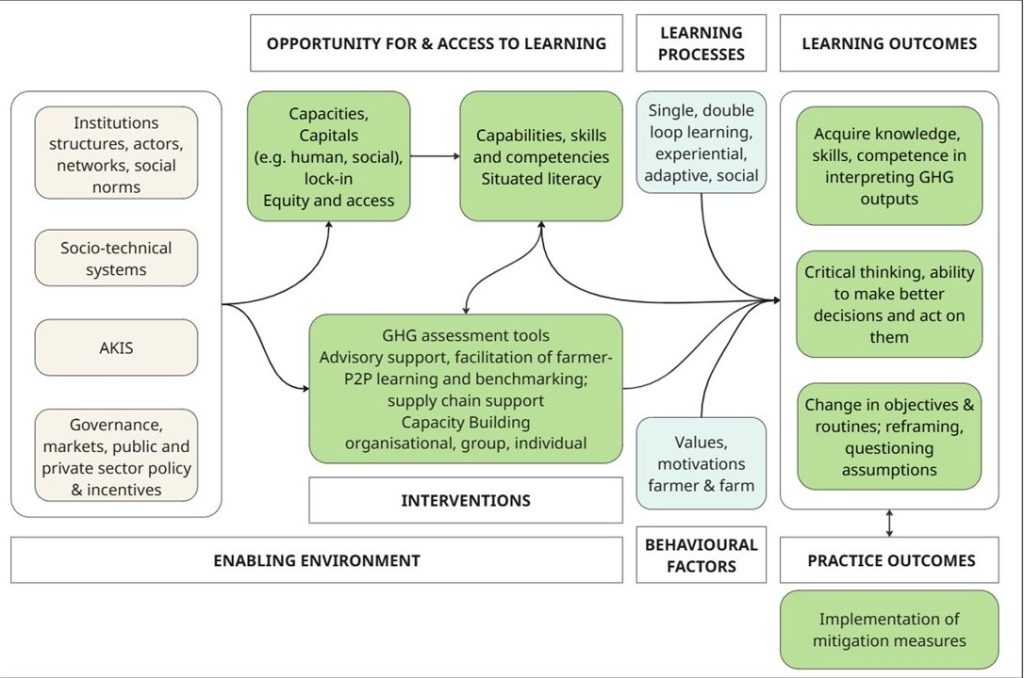
This framework has prompted a number of questions which the project is investigating, for example:
- To what extent do farmers and advisers have the capability, required competencies, skills and literacy to seek out, comprehend, evaluate, and use GHG assessment information to make informed choice about mitigation practices?
- How can institutions and governance strengthen the enabling environment to provide the means for farmers to access learning and act on that learning?
- How does checking their GHG emissions help farmers learn what to change, and how can different kinds of learning—like learning from others and trying things out reinforce learning and practice change, and help them cut emissions more effectively?
- What builds capacity to foster improved analytical skills, critical thinking, the ability to make better decisions, and strengthen confidence and farmers’ self-reliance?
- How do social and organisational factors—like local norms, routines, and rules—shape what farmer do in practice?
- Which parts of these tools work best for farmers and advisers, how does the way they’re delivered (in person, online, or through an intermediary) affect that, and what have people’s experiences with them been so far?
Read a summary of this work here.
We plan to report on progress on this website when our analysis is complete.
 LUNZ Footprint